
Key takeaways
- NAD is vital for healthy aging, energy metabolism, and cellular repair—but delivering it directly by injection hasn’t been proven to work.
- Scientific evidence for NAD shots is limited, relying mostly on anecdotal reports and animal data. Still, some people report short-term improvements in energy, mood, or mental clarity.
- Any benefits tend to be short-lived, lasting hours or days at best, and there’s no proof of long-term efficacy.
- Oral NAD precursors like NMN and NR are safer, better studied, and more convenient, working with the body’s natural pathways to raise NAD where it counts—inside the cell.
NAD therapy has officially entered the chat, and injections and IV drips are popping up in wellness clinics and med spas as the next big thing for energy, focus, and longevity. It all sounds great, but the science behind NAD injections is pretty thin. Before you fork over hundreds of dollars, here’s a facts-first account of the promises, the realities, and why it’s worth considering oral NAD precursors instead.
What are NAD injections?
NAD is short for nicotinamide adenine dinucleotide, one of the most important coenzymes we have. It’s involved in some 500 processes in the human body, including energy production, cellular repair, and antioxidant defense. NAD shots are capitalizing on the fact that as we age, NAD levels naturally decline. It begins as early as our 30s, and by age 50, most of us are running on half the NAD we had at 20. That’s a problem. While the great NAD decline is a normal part of the chronological aging process, it can also kickstart all sorts of age-related issues—think metabolic disorders like type 2 diabetes, neurodegenerative diseases like Parkinson’s and Alzheimer’s disease, and cancers.
Now, imagine a shot that delivers NAD straight to your bloodstream—quick and relatively painless. It sounds like that’s all you’d need to start boosting NAD levels to more youthful levels, right? You may have even seen marketing claims that by bypassing digestion, NAD injections are a quick fix for low energy, loss of focus, anti-aging, and the appealing but vague “detoxing.”
But… are they?
The promise vs. the proof
NAD shots sound almost too good to be true. Celebrities swear by them, biohackers hype them, and clinics market them as veritable miracle shots. Really, it’s no surprise that these things have exploded in popularity. There’s just one problem.
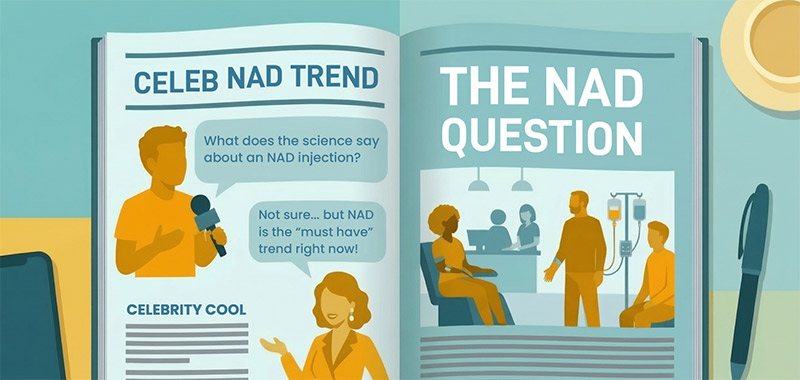
While NAD itself is absolutely critical for energy production and DNA repair and healthy aging, there’s very little scientific evidence that shows injections actually deliver any kind of lasting benefits. The same is true of the shot’s cousin, the NAD IV drip, which is a lengthier process involving infusing the coenzyme slowly through the vein.
So why is everyone acting like NAD shots are so great? Most of what’s out there comes from one of three places:
- Anecdotal reports, often straight from med spas reporting “patient experiences.”
- Small pilot studies with no control groups, often sponsored by medical spas and NAD drip clinics (hmm…) or in very limited contexts, like addiction treatment.
- Extrapolated data from research on NAD in cells and animals (not people). In essence, injections “borrow” the data that shows NAD restoration really does support mitochondrial health, DNA repair, and metabolism. The thing is, these benefits haven’t yet been proven to translate in humans when NAD is directly injected (or infused, for that matter).
Long story short? At this point, the buzz behind NAD shots and IVs is way ahead of the evidence.
About that NAD molecule…
There’s another piece to this puzzle. The NAD molecule itself is kind of a pain to supplement. For starters, it’s big and complex, so it doesn’t absorb well at all when it’s taken orally. In fact, in oral supplement form, not much of the NAD even makes it to the cell, which is where it’s needed. Wellness clinics and med spas actually make this part of the argument for NAD IVs and drips—delivering it straight to the bloodstream bypasses the digestive system entirely. That’s true, but again, we need NAD in the cell. The biggest hurdle is that the NAD molecule, in addition to being big and almost unwieldy, has a polar structure. That means it has both positive and negative charges, which gives it what’s known as hydrophilic characteristics. To put it another way, NAD molecules like mixing with water. But cellular membranes have a hydrophobic exterior and actually prefer molecules that don’t mix with water, so there’s a bit of gatekeeping going on here.
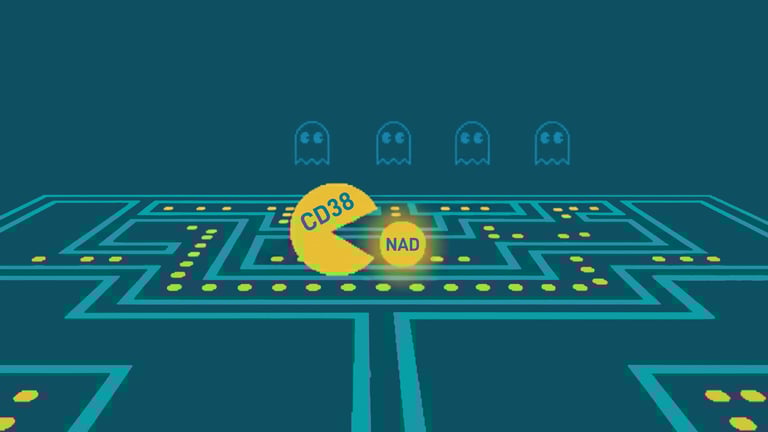
Even beyond absorption, the way NAD behaves in the body adds another layer of complexity. The prevailing theory is complex and subject to interpretation, but it goes something like this: NAD rapidly degrades in plasma into NAM, or nicotinamide, and ADR, or adenine diphosphoribose. NAM enters the cell, converts to NMN thanks to specialized enzymes, and then converts back to NAD. It’s speculative, but if it’s even partly accurate, it seems like an awful lot of work when there are more efficient ways (not to mention fully science-backed) to increase NAD.
What to expect before an NAD injection
Let’s say those celebrity endorsements are proving hard to ignore, and you’re dying to know what the actual NAD shot experience is like. It’s pretty straightforward. If you head to your nearest med spa or wellness clinic, you can expect a short consultation that runs through details like your medical history, current medications, and general hydration level. You’ll probably be advised to drink a lot of water before the shot is administered, since some NAD shots cause flushing, cramping, and nausea.
The injection itself is quick—the whole process takes just a few minutes, which may be really appealing when you consider that an NAD IV infusion can take two to four hours. Whether or not an NAD shot can be considered comfortable is pretty individual. Some people report mild stinging or burning, and nausea or lightheadedness aren’t uncommon. If you’re squeamish about needles, that’ll probably add to the negative experience.
The real pain might be in your pocketbook. Injections cost between $50 and $150 per shot, while IV drips can run anywhere from $400 to $1,000 per session, depending on the clinic and where you live. Of course, this is entirely out of pocket, since NAD infusion and injection therapy isn’t FDA approved or covered by insurance. For something that’s still considered experimental, it’s a steep price tag.
What to expect after an NAD injection
For most people, the appeal of the NAD shot comes from how they feel immediately following the treatment. We’re an instant-gratification society, so people feel validated when they notice some sort of immediate before-and-after effect. With NAD shots, people tend to report an “energy rush,” a sharper sense of mental clarity, and/or elevated mood.
To be clear, these are all subjective experiences, not measured outcomes. In other words, they’re based on individual reports instead of clinical data. Side effects after treatment are pretty common and generally include flushing, nausea, muscle cramping, headaches, or short-term fatigue. Most of this stuff is mild and fades pretty quickly. And really, since the idea is to bring NAD levels back to more youthful levels, the long-term results are arguably far more interesting, right? That’s where we run into more of an issue.
Long-term results: The evidence gap
When it comes to lasting benefits, the science just isn’t there yet. While some people describe real improvements in energy, brain fog, and recovery, the clinical research hasn’t caught up to the early enthusiasm. We’re still waiting on the kind of meaningful studies that would confirm what many users say they’re experiencing.
What is clear at this point is that any perceived boost is relatively short-lived (think: hours to a few days at most). It’s also worth weighing that and the costs involved against what the current evidence can actually support. NAD is undeniably essential for healthy aging, but injections haven’t yet proven to be the reliable way to restore it. Until more rigorous studies are done, it’s probably safer to think of NAD injections as an expensive experiment rather than a proven treatment.
Comparing NAD shots to oral NAD precursors
If you’re interested in NAD shots because you like the idea of restoring a sharper mind and feeling more energized, it’s worth learning more about NAD precursors. These oral supplements, like NMN and NR, have a whole lot going for them, and they outperform NAD shots and IV therapy in just about every way that matters.
- NMN and NR are more widely studied. There are a ton of studies into not only efficacy, but safety and tolerability. And at this point, we just can’t say the same about shots and IVs.
- NMN and NR are much more practical. There’s just no comparing the convenience factor and price point. With a daily NMN supplement like Wonderfeel Youngr™, you don’t have to make regular appointments, drive to the clinic, wait in the lobby, and then get stuck with a needle. Just make two Youngr™ capsules part of your morning routine, and get on with your life!
- NMN and NR work with the body’s pathways to restore NAD in the cell. There’s a lot that separates oral NAD precursors from NAD shots, but this is probably the most significant. NMN and NR aren’t trying to force the full NAD molecule into the blood and then hoping it somehow makes it into the cell (as we’ve covered, that’s a thorny path). Instead, NAD precursors are the literal building blocks of NAD—and the body already knows how to use them. Once they’re absorbed (which they do beautifully, by the way), NMN and NR are whisked into the cell and converted into NAD thanks to established enzymatic pathways. It’s like VIP access for these VIP molecules.
Ultimately, of course, the choice is yours. But knowing what’s what puts you in the best position to make that decision.
The bottom line: Before and after NAD therapy
Here’s what we know: NAD is essential in so many ways, but especially for energy production, DNA repair, and healthy aging. Here’s what else we know: oral NAD precursors like NMN and NR are a proven, evidence-based way to restore NAD where it counts—in the cell—and to do it safely and sustainably, in a manner that works with the body’s natural biology.
What we don’t know is whether NAD drips have any meaningful impact on raising NAD levels in the cell or provide any lasting benefits for energy, focus, or longevity. Any reports about amazing benefits are largely anecdotal, so keep that in mind. When you start to factor in the high cost, potential side effects, and complete lack of solid clinical evidence, well, the hype starts to look more like marketing than anything else. Luckily, there’s a handy workaround.
Frequently asked questions
How long does it take for NAD injections to work?
People generally report noticing an effect—an “energy rush” or sense of greater clarity—within minutes to hours after a treatment. These sensations tend to be subjective and relatively short-lived. Clinical evidence showing that NAD injections produce measurable or lasting increases in NAD levels inside cells doesn’t yet exist.
Does Jennifer Aniston take NAD?
In interviews, Jennifer Aniston has mentioned NAD therapy as part of her wellness routine. She’s one of several celebrities associated with the trend. Just remember that celebrity use is worth taking with a grain of salt. It’s not a substitute for clinical evidence, and the data on NAD shots and drips is still developing.
Do NAD injections really work?
We don’t know yet. NAD itself is vital for cellular health and energy metabolism, but questions remain about whether injecting NAD into the bloodstream definitely means it gets into the cell—where you need it. NAD precursors, like NMN and NR, have the advantage here, because they’re more readily absorbed and converted to NAD at the cellular level.
How will I feel after an NAD injection?
Some people feel energized, more alert, or in a better mood shortly after treatment, while others experience mild discomfort such as flushing, nausea, muscle cramping, or fatigue. These effects generally fade within a few hours. The “after” feeling varies from person to person and isn’t supported by clinical data—so it’s best not to go in with firm expectations.
What to avoid after an NAD injection?
There are no standardized aftercare guidelines, but clinics typically recommend drinking plenty of water and avoiding alcohol or intense exercise for the rest of the day, since dehydration and physical stress can make side effects like nausea or lightheadedness worse. If you feel flushed or fatigued, take it easy until symptoms pass.
How many times a week should I inject NAD?
There’s no science-backed dosing protocol for NAD injections or IV therapy. Some clinics recommend one to two sessions per week, while others suggest “loading” doses followed by monthly maintenance. Since there are no FDA-approved guidelines, frequency is entirely up to the provider’s discretion—which is worth keeping in mind as you consider your options. Oral NAD precursors like NMN or NR may offer a more consistent and evidence-based alternative for daily NAD support.