
Key takeaways
- ATP is the body’s primary energy currency, and every cell depends on it to function, repair, and regenerate.
- NAD makes ATP production possible by capturing and transporting high-energy electrons through cellular respiration.
- NAD is converted to NADH as it carries energy to the mitochondria, where most ATP is ultimately produced.
- NAD must be continuously recycled to keep cellular energy flowing in real time.
- NAD levels decline with age, which can reduce the efficiency of ATP production and overall cellular energy—making NAD precursors like Wonderfeel Youngr™ NMN worth considering.
Every second of every day, your body is hard at work making energy to keep the you show running. Your heart, your brain, your muscles, your cells—all of it runs on a tiny but oh-so-mighty molecule called adenosine triphosphate, or the more recognizable ATP. It’s widely described as the body’s energy currency because ATP is what your cells spend in order to do their jobs. But like any kind of currency, ATP doesn’t just appear out of thin air. Behind every tiny ATP molecule is a very complex biochemical relay that starts with an even tinier molecule: nicotinamide adenine dinucleotide, or NAD.

NAD has a starring role in cellular energy production, shuttling electrons that help cells turn foods you eat into usable energy. It’s a never-ending process that ensures ATP keeps flowing. And the fact of the matter is, without enough NAD, your cells can’t efficiently make the energy they need to function as they should. We’ll remind you that NAD naturally declines with age, setting up a pretty significant dilemma.
Let’s break down all the steps in this energy relay, along with what you can do to maintain robust NAD levels for strong cellular energy, efficient ATP production, and long-term vitality.
NAD and cellular energy: The tiny molecule running the show
NAD may be microscopic, but its job in the body is anything but small. This humble little coenzyme is involved in hundreds of cellular processes, including DNA repair, antioxidant defense, and, yes, energy production. It accomplishes that last feat by serving as a glorified electron shuttle bus, picking up high-energy electrons during the breakdown of food and delivering them to the cellular machinery that ultimately produces ATP.
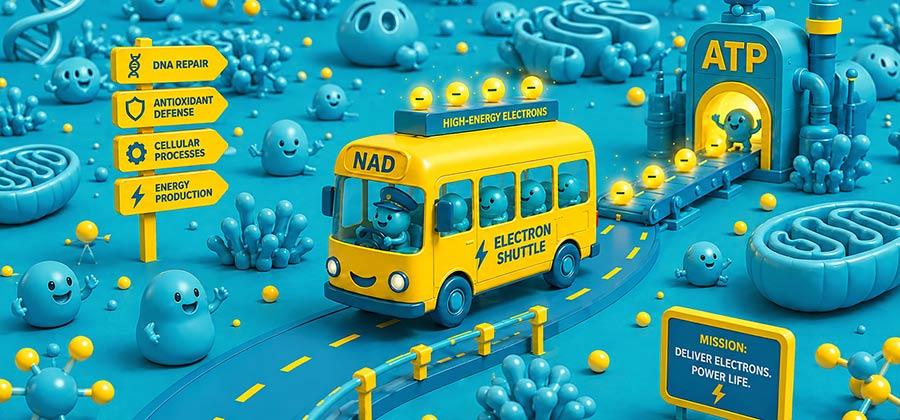
So how does it work? It starts at mealtime, when your body begins pulling energy from carbohydrates, fats, and proteins—the macronutrients in the food you eat. As these nutrients are broken down, their chemical energy makes its way through a series of reactions. NAD is one of the most essential carriers along the way, switching between its oxidized form (NAD) and its reduced form (NADH) as it moves electrons through your cells.
The back-and-forth between NAD and NADH is constant, and that’s what keeps cellular energy production running. The concept is straightforward (even if the actual process is incredibly complex)—NAD picks up electrons, NADH drops them off, and the cycle repeats over and over again to support steady ATP output. When you have enough NAD, the whole process is smooth and efficient. But when NAD levels drop, as they do naturally with age, well, there’s a downstream effect. ATP production becomes less efficient, and cells struggle to meet the demands of everyday metabolism, repair, and regeneration.
In other words, NAD helps determine how effectively your cells can make and use energy. It doesn’t just support energy production—it helps regulate the pace and efficiency of the entire process. That’s why NAD is so tightly linked to how energized, resilient, and metabolically healthy your cells can be over time.
How NAD creates ATP: The big picture of energy production
NAD doesn’t actually create ATP directly—it just makes the whole process possible. Let’s break it down.
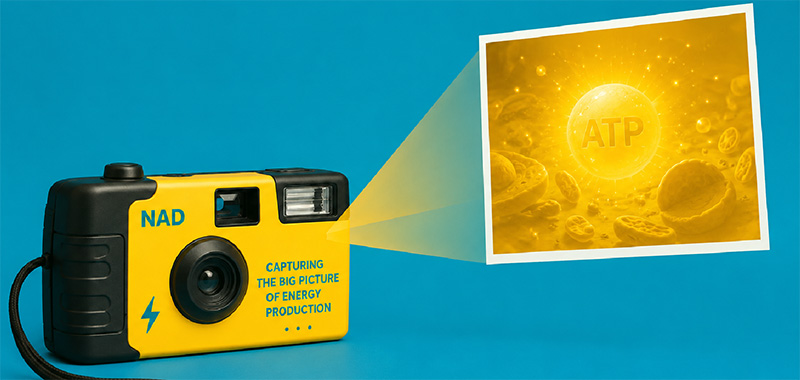
NAD is basically the courier
High-energy electrons are essentially the raw energy released as macronutrients are broken down. When your body processes food, it strips electrons away from nutrients—electrons that need to be safely transported through the cell. NAD is the molecule that picks them up. Without NAD to accept and shuttle those electrons, energy extraction from food would stall pretty darn quick.
The first spark: NAD in glycolysis
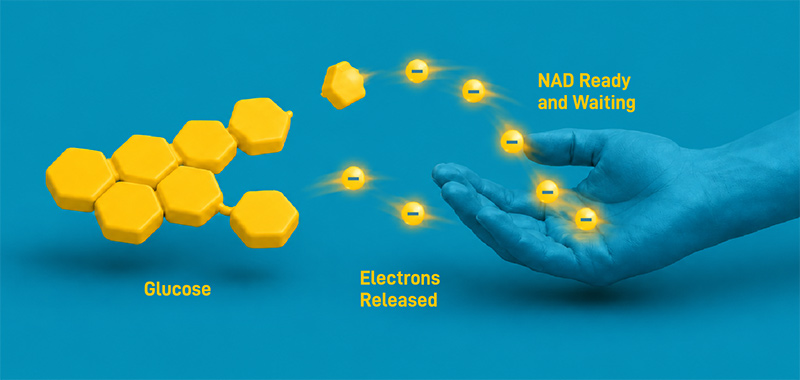
You probably remember the mitochondria as the powerhouse of the cell from Bio 101. It’s a nickname that recognizes the mitochondria’s role as an energy producer. But the energy-making process actually starts outside the mitochondria in a pathway called glycolysis, where glucose is broken down into smaller molecules. This is when electrons are released for the first time, with NAD ready and waiting to grab them.
Converting NAD to NADH for energy storage
When NAD picks up those electrons, it becomes NADH, its charged or reduced form. The “H” stands for hydrogen, indicating that an NAD molecule has gained two electrons and a proton. It’s another essential step in an essential process because NADH is the temporary energy storage and transportation molecule, responsible for delivering electrons to the mitochondria. That’s where the final and most productive phase of ATP synthesis takes place.
The NAD to NADH conversion relies on robust NAD levels for obvious reasons—less NAD means fewer NADH molecules are formed, which means less energy delivered to the ATP-making machine.
The final sprint to ATP: NAD and the electron transport chain
When NADH has made it safely into the mitochondria, it drops off its cargo in the electron transport chain, which is essentially a bunch of protein complexes in the mitochondrial membrane. Electrons move through this chain, and their energy powers an enzyme known as ATP synthase.
Once NADH has made the electron drop, it becomes NAD again, and it’s ready to head back out to pick up more energy. It’s a constant loop, and it’s why ATP production can continue without interruption.
Where creatine fits into the energy picture
If you know anything about creatine, you may be wondering where exactly it fits into the equation. While NAD has a foundational role in making ATP, creatine comes in later. It’s involved in the management and recycling of ATP once it’s already been made.
In the body, creatine is stored as phosphocreatine, which means it’s on hand for sudden energy demand spikes. It’s kind of like an on-demand backup that helps smooth out energy fluctuations. The body relies on both NAD and creatine to support different aspects of cellular energy—one builds the energy supply, and the other helps manage demand.
A word on mitochondrial function and NAD
None of this works without healthy mitochondria. The powerhouse of the cell moniker is bang on, and NAD is one of mitochondria’s most essential fuel handlers. Efficient ATP production in the mitochondria is heavily dependent on a steady supply of NAD to deliver electrons into the electron transport chain.
When everything goes as intended—healthy mitochondria, lots of NAD—ATP production is smooth and robust. But a chink in the chain at any point means cellular energy output nosedives. And that’s something you recognize in fatigue, slower recovery times, and reduced metabolic resilience.
How NAD keeps cellular energy flowing
Our cells don’t stockpile reserves of ATP. They rely on a steady stream of energy, and NAD is what makes that possible. Every time NAD accepts electrons and becomes NADH, it’s carrying energy forward in the system. Every time NADH drops off electrons and becomes NAD again, the loop resets and begins again. It’s an ongoing process in real time that allows our cells to respond instantaneously to changing energy demands—a sprint up the stairs, a late-night brainstorming sesh, or behind-the-scenes cellular repair while you sleep. And it might make you wonder—what happens when NAD becomes limited?
What happens to ATP when NAD levels decline with age?
We’ve already noted that NAD levels naturally decline with age. Blame inflammaging and metabolic stress and other causes we’re still figuring out. It has body-wide effects, but let us focus solely on energy production. All of that ATP-making machinery is still there, but without sufficient NAD supplying a steady stream of electrons, it’s no longer running at full speed.

Cells may begin struggling to keep up with energy demands, and over time, that can affect their resilience to stress, their ability to recover, and how efficiently they maintain normal metabolic function. Zoom out to body-wide effects: Reduced cellular ATP production is closely associated with the same stuff we chalk up to aging. Think lower energy, slower recovery, reduced endurance, and less metabolic flexibility. It’s true that there are a lot of players that affect how we age, but declining NAD is a big one.
The takeaway: Why NAD support matters for real-world energy
ATP may be the energy your cells spend, but NAD is what keeps the supply chain moving. Every heartbeat, muscle contraction, thought, and repair process depends on the constant recycling of NAD to carry electrons and fuel ATP production inside your mitochondria—and supporting your body with a high-quality NAD precursor can help maintain this vital energy pathway. Wonderfeel Youngr™ NMN is designed to deliver a clinically valid dose of NMN is its most bioavailable form, giving your body the raw material it needs to replenish NAD and keep ATP production running efficiently at the cellular level.

Frequently asked questions
How is NAD used to make ATP?
NAD carries electrons that come from the breakdown of food. As our bodies process nutrients, NAD picks up high-energy electrons and turns into NADH. NADH shuttles these electrons into the mitochondria, where they enter the electron transport chain and kickstart ATP production.
What is the relationship between NAD and ATP?
NAD is what makes ATP production possible. ATP is the energy our cells need to function, and NAD is the molecule that moves the electrons required for ATP production. If you don’t have enough NAD to shuttle electrons, the whole ATP-making process slows down.
Does NAD carry electrons to make ATP?
Yep! Carrying electrons is NAD’s main role in energy production. It picks them up when nutrients are broken down from food we eat and then takes them to the mitochondria, where they’re used to generate ATP.
What is the role of NAD in glycolysis?
In glycolysis, NAD picks up electrons as glucose is broken down. That’s what converts NAD to NADH.
Why is NAD essential for cellular energy?
Cells can’t produce ATP efficiency without NAD. It shuttles electrons to the mitochondria to support energy production and needs to be recycled again and again to keep energy flowing in real time. As NAD levels decline with age, cellular energy production becomes less efficient, affecting endurance, recovery, and overall metabolic function.