

Key takeaways
- Dr. David Sinclair is one of the most influential voices in longevity science, and his personal supplement and lifestyle choices are frequently discussed—but often misunderstood.
- While Dr. Sinclair does not endorse specific brands, he has publicly discussed a core set of compounds he finds promising, including NMN, resveratrol, and vitamin D.
- Some supplements historically associated with Sinclair, such as metformin, fisetin, spermidine, and aspirin, are no longer clearly part of a consistent daily regimen.
- In recent years, Sinclair has shifted focus away from a fixed “stack” and toward personalization, biomarker tracking, lifestyle interventions, and emerging longevity pathways.
- Supplements are only one part of Sinclair’s broader longevity framework, which prioritizes nutrition, exercise, metabolic health, and ongoing scientific validation.
David Sinclair is one of the most influential—and most searched—figures in longevity science, and questions about the supplements he takes come up constantly. A long-time biohacker and admittedly controversial Australian biologist, Sinclair has an impressive resume. He’s a professor in the Department of Genetics at Harvard Medical School, the author of Lifespan, and the founder of the Sinclair Lab, a world-renowned research group at Harvard dedicated to understanding why we age and what might be done to reverse it. His work has made compounds like NMN, NAD, and resveratrol household names in the longevity world.
While many articles still circulate outdated “daily stacks,” Sinclair himself has clarified that his personal anti-aging protocol is not fixed. Instead, it evolves with emerging human data, biomarker tracking, and lifestyle context.
Below is a current, evidence-based breakdown of the supplements David Sinclair has consistently discussed, those he has reconsidered, and others he views as experimental—based on his own recent public statements.
David Sinclair’s supplement list at a glance
This table reflects supplements David Sinclair has discussed publicly, not a fixed daily regimen.
| Supplement | Current Status | Context/Rationale |
|---|---|---|
| NMN | Consistent | ~1 g daily |
| Resveratrol | Consistent | Taken with a fat source |
| Vitamin D3 | Conditional | Based on blood levels |
| Metformin | Reduced/Paused | Exercise concerns |
| Fisetin | Experimental | Intermittent research |
| Spermidine | Discussed | Not confirmed daily |
| CoQ10 | Conditional | Often tied to statin use |
| Statins | Medical/personal | Based on cardiovascular risk |
| Vitamin K2 | Discussed | Not consistently confirmed as daily |

What supplements does David Sinclair take consistently?
David Sinclair has most consistently discussed NMN, resveratrol, and vitamin D as part of his longevity approach. He regularly emphasizes that dosage, frequency, and necessity depend on biomarkers and emerging human data—not a fixed daily stack.
Let’s take a closer look at the supplements Sinclair has most reliably referenced in the last few years.
1. Nicotinamide mononucleotide (NMN), 1 gram daily
NMN is the most consistently referenced supplement in David Sinclair’s longevity protocol.
He has repeatedly stated that he takes approximately 1 gram (1000 mg) of NMN every morning. His preference for NMN over NR is based on bioavailability and lab-based evidence, including NMN’s role as a direct precursor to NAD.
“I take one gram of NMN every morning along with my resveratrol. The reason is in humans, we know that doubles NAD levels, which is important because someone my age has half the levels of NAD than I did when I was 20.” – David Sinclair
Many experts in the longevity science field long had a hunch that stronger doses would deliver the real benefits of NMN, and the latest research confirms this. The most recent clinical study, and the most comprehensive to date, assessed the effects of NMN administered in placebo, 300 mg, 600 mg, and 900 mg doses. After comparing three specific biomarkers before and after the 60-day study, researchers determined that not only did all three NMN groups outperform the placebo group in spades, the 900-mg group performed the best.

Sinclair is still careful to point out that human longevity data is still emerging, and that NMN is best viewed as a promising tool rather than a longevity miracle.
NMN is a precursor to NAD, the fundamental driver of our energetic status at the cellular level. As we age, NAD production naturally decreases. It’s a decline linked to various age-related diseases. But NMN can jumpstart NAD production, essentially turning back the biological clock.
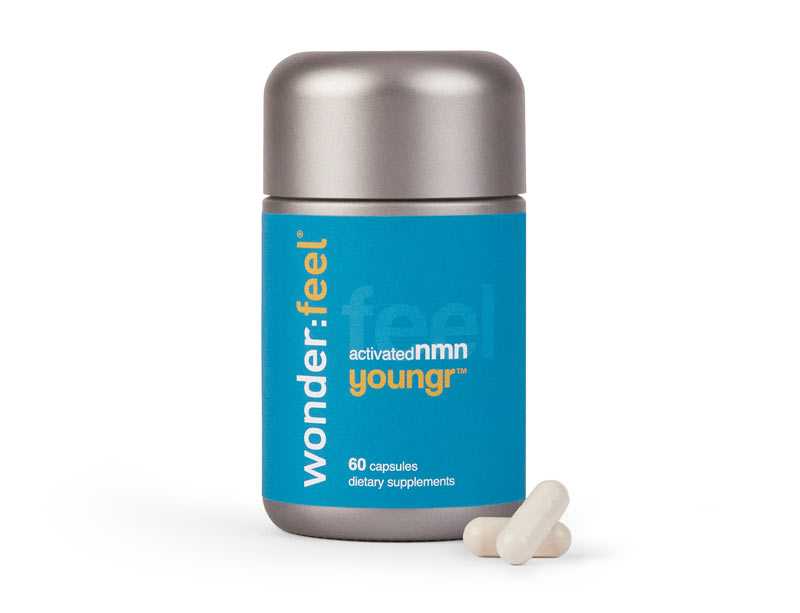
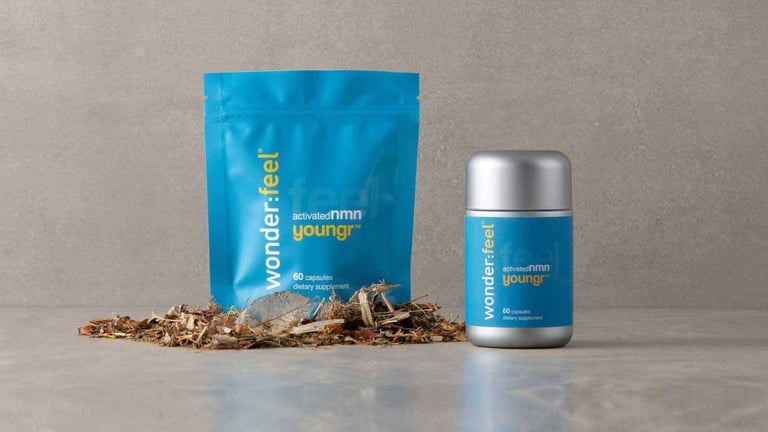
Of course, we’re partial to Wonderfeel’s patented Youngr™ NMN, a proprietary blend of powerful antioxidants and NMN in a dose scientifically proven to deliver the greatest efficacy. It’s a combination that supercharges the ability of NMN and NAD to be effective in the cell.

NMN alone is quite beneficial, explains Wonderfeel Chief Medical Officer Professor Andrew Salzman, a Harvard MD and one of today’s most prominent drug inventors. However, the efficacy of NMN isn’t limited to restoring NAD. It’s just as important to reduce the factors that accelerate NAD breakdown—and CD38 is a big one. By pairing Wonderfeel’s NMN with specific antioxidants, we ensure two things: first, shielding our cells from ubiquitous oxidative stress present throughout our bodies, and second, allowing our cells to generate NAD more effectively with the NMN that is simultaneously delivered.
2. Resveratrol: 1 gram daily (take with fat)
Resveratrol is an anti-inflammatory compound that can reduce the risk of cancer, neurodegeneration, and heart disease, and it’s been a cornerstone of Sinclair’s work for more than a decade. This polyphenol is abundantly found in the skin and seeds of grapes, and it has a lengthy list of health benefits. Dr. Sinclair pairs approximately 1 gram of resveratrol daily with NMN because of their synergistic relationship (and we agree!). It activates sirtuins, a family of proteins that help regulate cellular health. Sirtuins are NAD-dependent, meaning they only function properly with adequate levels of NAD.
Resveratrol, while beneficial, has a nuanced dose-response relationship, and that’s something Sinclair has acknowledged in recent years. Research shows that at lower doses, resveratrol is effective in providing health benefits without any associated risks. Higher doses, on the other hand, can interfere with essential cellular processes and even lead to cell death.
Wonderfeel’s 100mg dose in the Youngr™ formula is thoughtfully balanced to support sirtuin activity while avoiding the potential downsides associated with excessive intake.
3. Vitamin D3, dose based on blood levels
In his book, Sinclair writes that he takes a daily dose of vitamin D, but doesn’t clarify how much he takes. More recently, he has stated that he supplements with D3 when his blood levels fall below optimal levels.
In addition to defending against heart disease, type 2 diabetes, Alzheimer’s disease, and autoimmune disorders, vitamin D3 plays a vital role in numerous critical functions in the body. It aids in insulin production and immune function, but it also contributes to the generation of stem cells in the gut, one of the foundations for good health. Research also suggests that vitamin D3 may help extend lifespan. A surprising number of people are deficient in this vitamin and don’t even know it. That’s why Sinclair emphasizes testing and personalization instead of a fixed daily dose for everyone.
Vitamin D3 is included in the Wonderfeel Youngr™ formula. Each serving has 20 mcg, which is 100% of the recommended daily value according to the U.S. Food and Drug Administration.
Supplements David Sinclair has reconsidered or uses selectively
Several supplements frequently attributed to David Sinclair—such as metformin, aspirin, fisetin, quercetin, and spermidine—are no longer clearly part of a consistent daily regimen. Instead, Sinclair talks about these compounds as experimental, situation, or within key contexts. Again, he’s quick to point out that emerging human data has reshaped his thought process.
Let’s review.
1. Metformin, used previously and now approached cautiously
Metformin is a prescription drug often taken by diabetics. There is evidence that it can improve lifespan in mammals, but it does have short and long-term side effects, including diarrhea, gastrointestinal discomfort, and the potential for a reduction in B12 absorption in time. However, its potential as a longevity medication is promising enough for extensive clinical study. The Targeting Aging with Metformin (TAME) Trial is a series of six-year clinical trials at 14 research institutions across the nation. The goal is to test whether people taking metformin experience any delays in the development or progression of various age-related chronic diseases, including cancer, dementia, and heart disease.
Metformin is a frequent topic of discussion for Sinclair, but its status as part of his current protocol has changed. While he has stated that he used to take metformin regularly, he has reduced or paused its use based on evidence that suggests it could alter exercise-induced adaptations. Sinclair no longer recommends metformin broadly for healthy adults. Currently, he frames its use as dependent on context and experimental as a longevity solution.
2. Baby aspirin, no longer emphasized
There is mixed evidence that a low dose of aspirin taken daily can reduce inflammation and reduce heart attack risk. However, recent evidence is contradictory and shows that low-dose aspirin taken daily might actually increase cancer risk.
Reflecting this shift in evidence, Sinclair no longer emphasizes baby aspirin as part of a standard longevity approach.
3. Spermidine, discussed favorably but not confirmed as daily use
Spermidine compound is found in various food sources, including wheat germ, cheese, and vegetables. It may prevent common causes of liver cancer, and research shows that it can improve certain health and longevity biomarkers.
While Sinclair has spoken positively about spermidine thanks to its association with autophagy and cellular maintenance, there’s no evidence that he currently takes it as part of a daily high-dose supplement. Gram-level dosing isn’t supported by existing human research. Call it a compound of interest, not a confirmed part of Sinclair’s routine.
4. Fisetin and quercetin, senolytics (not daily supplements)
Fisetin and quercetin are plant flavonoids found in a variety of fruits and vegetables, including strawberries, apples, onions, and grapes. Both compounds have been studied for their potential senolytic properties, meaning they may help target senescent cells (AKA zombie cells) that accumulate with age.
Sinclair has discussed senolytics broadly as a promising area of longevity research, but he hasn’t stated that he takes fisetin or quercetin daily. In research settings, senolytics are typically explored using intermittent or pulsed dosing, not continuous supplementation.
5. Vitamin K2, discussed but not consistently confirmed
An important vitamin for bone, vascular, and mitochondrial health, K2 is often taken with vitamin D to optimize bioavailability. Still, K2 isn’t recommended for everyone, and Sinclair hasn’t consistently confirmed it as a daily supplement in his own routine. People taking blood thinners, particularly warfarin, should avoid K2 because it interferes with these medications. Those with kidney issues or genetic blood clotting conditions are advised to steer clear.
The Wonderfeel Youngr™ formula notably excludes vitamin K2 for two reasons. First, it’s found in a wide range of foods – think hard cheeses, egg yolks, beef, and salmon. Second, there simply isn’t enough clinical evidence that vitamin K supplements are beneficial.
Additional compounds David Sinclair has discussed
Beyond the supplements he talks about most consistently, David Sinclair has also mentioned a handful of other compounds in interviews, lectures, and longevity discussions. These aren’t part of a set daily routine. Instead, they tend to come up in specific contexts—like metabolic health, cardiovascular risk, or emerging research.
Here’s how these compounds fit into the bigger picture.
Alpha-lipoic acid (ALA)
Alpha-lipoic acid (ALA) is a mitochondrial antioxidant involved in energy metabolism and insulin sensitivity. It’s often studied for its ability to help reduce oxidative stress and support metabolic health, especially as we age.
Sinclair has brought up ALA in conversations about mitochondrial function and metabolic aging, but he hasn’t said it’s something he takes every day. Instead, it shows up as a compound he finds interesting from a research perspective—not a core part of his personal routine.
Coenzyme Q10 (CoQ10)
CoQ10 plays an important role in mitochondrial energy production and overall cellular health. Since the body’s natural CoQ10 levels tend to decline with age, it often comes up in discussions around aging and heart health.
Sinclair has acknowledged CoQ10’s importance, particularly for people taking statin medications, which can lower CoQ10 levels. That said, he hasn’t publicly said that he supplements CoQ10 on a regular basis. When it comes up, it’s usually framed as situational, depending on medications, energy needs, and individual health markers.
Trimethylglycine (TMG/Betaine)
TMG—also known as betaine—supports methylation pathways and helps keep homocysteine levels in check. You’ll often see it mentioned in longevity circles alongside NAD metabolism and cardiovascular health.
While TMG gets a lot of attention online, Sinclair hasn’t clearly said that he takes it routinely. When he does talk about it, it’s more in the context of personalized supplementation, especially for people tracking methylation or homocysteine markers.
Statins
Statins are prescription medications used to manage cholesterol and reduce cardiovascular risk. Sinclair has said that he takes—or has taken—a statin based on his own cardiovascular risk factors, not as a blanket anti-aging strategy.
He’s been clear that statins are a medical decision, not a longevity hack. Whether they make sense depends on your lipid levels, family history, and guidance from a physician—not trends in longevity science.
Why this matters
One of Sinclair’s biggest points is that longevity isn’t about copying someone else’s supplement list. Many of the compounds discussed above are highly individual, and whether they make sense depends on your biology, biomarkers, and health goals.
That’s why Sinclair continues to emphasize personalization, testing, and restraint—especially as the science continues to evolve.
A lifestyle designed for longevity
Supplements are just one part of David Sinclair’s longevity framework. He consistently emphasizes that daily habits, metabolic health, and data-driven decision-making matter more than any single pill.
Nutrition is the foundation of Sinclair’s approach. He’s a proponent of green tea and minimizes alcohol consumption. He eats a small amount of red meat on days he weight trains and prioritizes vegetables. He fasts and aims to eat a single meal daily, which technically makes him an OMAD (one meal a day). At age 40, he gave up desserts while keeping sugar and refined carbohydrates like pasta to a minimum.
Exercise is non-negotiable. He runs several times weekly, lifts weights, and boxes regularly. His goal isn’t aesthetics—it’s maintaining strength, cardiovascular fitness, and resilience as he ages. He also incorporates heat and cold exposure, which he’s discussed as tools for stress adaptation.
Dr. Sinclair doesn’t smoke and tries to minimize excessive UV exposure, as well as X-rays and CT scans, which he believes may contribute to epigenetic stress over time.

As a scientist, Dr. Sinclair is very data-minded. He uses continuous glucose monitors to track blood sugar and completes regular blood tests as well.
Does David Sinclair’s Approach Work?
Sinclair often shares that his goal isn’t perfection or immortality—it’s extending healthspan, the number of years spent in good health.
In December 2021 Sinclair tweeted a graph showing his biological age compared to others his age. According to his biological markers, he’s a full ten years younger than people who were born in the same year, something he credits directly to his lifestyle and supplements. That’s the thing about Dr. Sinclair—he’s a living example of what he preaches. And considering his field of expertise, that’s saying something.
Frequently asked questions
What brand of NMN does Dr. Sinclair recommend?
Longevity expert Dr. David Sinclair doesn’t publicly recommend a specific NMN brand. However, he said he takes 1 gram of NMN per day, along with resveratrol and vitamin D3. A daily serving of Wonderfeel Youngr™ NMN has 900mg of NMN, along with resveratrol, ergothioneine, hydroxytyrosol, and vitamin D3.
What is Dr Sinclair’s anti-aging regimen?
Dr. David Sinclair’s anti-aging regimen is pretty comprehensive and includes things like intermittent fasting, calorie restriction, strength training, sleep optimization, cold exposure and heat therapy, stress management, and experimental gene therapy. He also takes supplements like NMN and resveratrol every day.
Why does David Sinclair take NMN instead of NR?
Dr. David Sinclair has said that while both are effective, he personally prefers NMN to NR because it’s the direct precursor to NAD and has its own transporter into the cell, which makes it more efficient. Plus, his own research has focused on NMN as well.
Is Sinclair taking NMN or NAD?
Dr. David Sinclair, a renowned longevity expert, says he takes NMN as part of his anti-aging regimen. NAD can’t be absorbed from external supplements, but NMN absorbs well in the body and is converted into NAD in the cell to effectively raise NAD levels for longevity benefits.
Does Dr. Sinclair still take resveratrol?
Yes. David Sinclair has consistently stated that he takes resveratrol, typically around 1 gram daily with a fat source, though he now emphasizes nuance around dosing and emerging human data.
Does Dr. Sinclair recommend new supplements for 2026?
David Sinclair hasn’t rolled out a new list of must-take supplements for 2026, but he has publicly stated he takes NMN, resveratrol, and vitamin D3. He continues to emphasize that longevity science is still evolving and that supplement choices should be driven by human data, biomarkers, and individual needs—not trends. His approach favors a small number of well-studied compounds alongside strong lifestyle fundamentals, instead of constantly adding new supplements.